Friday, 1 October 2010

October

As today we start the month dedicated to Our Lady of the Rosary, we lift our eyes towards heaven in admiration of that great little Doctor, Therese of Lisieux.
I recall with joy the vivid images in my mind of her relics in Aylesford Priory this time last year. What a moment of grace for so many it was and what a splendid forerunner to the publishing of Anglicanorum Coetibus and the visit of the Holy Father to our beloved nation. Both visits encouraged English Catholics in their patrimony and calling, and encouraged many Anglicans too, a year ago today her relics rested in York Minster.
The writings of Therese are inspiring and infused with pure love towards Our Lord, a 24 year old heart that reached perfection! How far away I am from that pure love but what encouragement and consolation her witness and her writings are. One of the sentences she wrote which I like to remind myself of often is the following: “Our Lord needs from us neither great deeds nor profound thoughts; neither intelligence nor talents. He cherishes simplicity.” This sentence speaks to me of the necessity of simplicity in life which flows from simplicity in prayer, or better still the prayer of simplicity.
At the heart of the prayer of simplicity is the simple but profound prayer of the Rosary, an aid and a focus to arrive at the still and simple heart of prayer. For those who this devotion is part of the essential diet, this month encourages us to rejoice as we explore new depths, for those who do not pray the Rosary this is the time to explore it. It comes highly recommended.
By gently repeating the biblical words of the Lord’s Prayer and the Hail Mary and by rejoicing in the doxology that praises Father, Son and Holy Spirit we reflect on twenty moments of great blessing, the mysteries of the Rosary on different days of the week, so that in a whole week we meditate on the mysteries of our salvation. We become familiar with these saving events and they will take deep root in our lives, they will form and shape us in being more Christ-like.
I recommend to you to take up your rosaries and let this prayer carry you in those green pastures were our Lord resides. This month I am offering my rosaries for those reflecting on joining the Anglican Ordinariate, and those who are struggling with it. May this prayer be a balm of peace and unity to all Anglo-Catholics wherever they may be. Would you care to join me?

Wednesday, 29 September 2010

Of Ordinariates and Societies

Cardinal Levada (right) and Arcbishop Di Noia OP launching the Apostolic Constitution "Anglicanorum Coetibus"

I was in need of time to reflect after the meeting of clergy convened by a number of Anglican Catholic bishops last Friday in London. Sadly, time is in short supply and the weekend was crammed with various exciting events.
On Saturday morning, we had the “Fan the Flame Week” follow up day where over twenty people met in the school hall to reflect on the experience and start flagging up ideas about our life in the coming years. Mrs Barbara Robinson led the day for us brilliantly. We looked at four main areas: the Loving Church, the Worshipping Church, the Learning Church and the Mission shaped Church. The suggestions in these four areas will be discussed by the PCC.
That same day we had the wedding of Beverley and Craig, two members of our congregation. It was a joyful occasion supported by a full choir, a good number of us and their family and friends. We wish Bev and Craig the very best. Photos of these two occasions will be uploaded later.
Monday and Tuesday was taken up by Heythrop College. I am starting some studies there so Monday evening and my day off on Tuesday I spent acclimatising myself with the institution and resources and started writing some essays too. The last formal studies I did were ten years ago, so there is some adjustment to be made. So far, I have found my time there refreshing.
This hopefully explains why I am posting my reflections about the clergy meeting that took place last Friday today.
I am sure it is no surprise to anyone that the Anglo-Catholic house is divided. I have said and written many times that this for us is a time of prayer, reflection and decision-making. We need to do all these on our knees and with our eyes fixed on the Lord. We must follow our consciences after we have heard all the arguments, and studied all the details. Whatever decisions we make we need to embrace them hopefully and joyfully and once more repeat myself in saying that we need an environment of deep respect, mutual love and genuine support. Wherever people might be heading off we need to ensure that they have the necessary for their journey. Short of this, we do not deserve to be called Christians. I know that there is a lot of pain and a lot of uncertainty which leads people to uncomfortable places and there find it easy to say what should rather be left unsaid, but when we find ourselves there we need to realise that our place is only in the presence of the Lord.
It seems that there are now three options for Anglo-Catholics, especially priests.
The first is to remain where one is and do nothing or do what always has been done. For priests this means to ignore what is going on in the wider Church and carry on as usual until retirement or resignation. It may also mean that the priest will respect and accept the decisions of General Synod and live with the innovations as best as he can. This means that no big decisions will be needed and that the income and domestic arrangements are assured which give the necessary stability on which to perform a solid ministry.
The second option is the newly formed (forming) society of St Wilfred and St Hilda. So far, what the aims and objectives are is not clear so while some are joining it already others will want to wait and see. For a priest this means a few more years with honour in the CofE without accepting any of the innovations. The society may or may not secure some sort of provision or stronger code of practice. It may also be an honoured vehicle for those who for personal or ecclesial reasons cannot be part of the Catholic family. If General Synod gives no juridical strength to this institution it might carry on based on the continuing models in the States. However, this might bring back problems of buildings, finances etc… in a few years time.
The third option is the generous and loving offer from the Holy Father: the Ordinariate. Although it does not yet exist, we are told that it will in the next few months. We have the Apostolic Constitution to go by as also the complementary norms and the official commentary. Some are saying that the UK RC bishops are not looking forward to welcome Anglican priests, but as this is hearsay it is wise to wait and see. A priest with a group of faithful will be received in the Catholic Church and can have an honoured life there as Anglicans in full communion with the Holy See. There will be a first wave of people who will work hard to chart these unchartered waters and as things become clearer others might want to follow.
At this time, we need to allow people to reflect on these options, and maybe others that I cannot now see, but we need to urge each other to pray and wait on God whilst tenderly caring for each other. Those going in any of the above categories have been hurt and abused by the CofE and in that pain it is easy to reflect the disappointment on one another. Keeping our eyes on the Lord of healing will enable us to stand to any temptation and walk forward in faith, hope and love; especially as we have the added pain of realising that the parting of friends is drawing near.
Wherever we are called to go and be let us go with joy, confidence and love knowing that our time together has formed and shaped us and equipped us for the journey ahead.

Ss Michael, Gabriel and Raphael, Archangels


Saint Michael the Archangel, defend us in battle, be our protection against the malice and snares of the devil. May God rebuke him we humbly pray; and do thou, O Prince of the Heavenly host, by the power of God, thrust into hell Satan and all evil spirits who wander through the world for the ruin of souls. Amen.

Sunday, 26 September 2010

Congratulations Fr Chad!

This comes rather late but the photos have only just made their way across the Atlantic! Many congratulations to Fr Chad Hart who was ordained to the Sacred Order of Deacons last Saturday. More photos will be posted if they appear.

Saturday, 25 September 2010

Blessed Chiara Badano (1971-1990)

Blessed Chiara, pray for us.


Thursday, 23 September 2010

Harvest at Gloucester House Nursing Home


John has led the Harvest Festival at the above home. It was great to see so many residents taking part. John takes great pastoral care of them. The display was great and the singing, with the kind help of Marigold on the keyboard, joyful.

Wednesday, 22 September 2010

Bishop of Ebbsfleet Pastoral Letter: Joining the Ordinariate


The Bishop of Ebbsfleet, the Rt Revd Andrew Burnham, has published a Pastoral Letter which is well worth reading. This is the third of a series of letters designed to examine the possible future for Catholic-minded Anglicans. The other two letters can be viewed:

August 2010 - The General Synod at York
September 2010 - Electing a new General Synod

October's letter addresses the subject Joining the Ordinariate and is reproduced here:

In this, the third of a series of Pastoral Letters, I promised to address the issue of the English Ordinariate. In August I looked at what had happened at the General Synod in York and in September I looked at the business of electing a new General Synod.

Those who join the new Ordinariate, offered by the Pope in Anglicanorum Cœtibus in the autumn of 2009, will do so for one of two reasons. One reason would be that, looking hard at the General Synod, past and future, there seems little prospect of adequate provision for Anglo-catholics in the Church of England. We don't need a glasshouse with a special climate, or an Indian Reserve where we can do strange dances round a totem pole, follow strange customs, and wear strange clothes. Still less do we need some kind of nursing home where we can live out our days in peace and quiet.

In our view, Anglican the orders of bishop, priest, and deacon, and Anglican sacraments, are either the ancient orders and sacraments of the Church, as they have been handed down to us from the time of the apostles, or they are not. You can't muck about with orders and sacraments! If Anglo-catholic orders and sacraments are not the same as those of other Anglicans, we are not proper Anglicans, and if Anglican orders and sacraments generally are not the same as those of other Catholic Christians, East and West, then our orders and sacraments are not Catholic. Our main problem is not with our own orders and sacraments at this present moment in Anglo-catholic parishes, but what has been happening with other Anglicans. This has already begun to affect our orders and sacraments and what they will be in the future.

There are stories of people no longer being baptised 'in the name of the Father, and of the Son, and of the Holy Spirit'. There are stories of people - even a dog! - being admitted to Holy Communion without being baptised. There are stories of people no longer using wheat flour and grape for the Eucharist or making up the order of service as they go along. There are stories about lay people presiding at the Eucharist. There are marriages of two people of the same sex. These are mostly stories from overseas but, leaving aside what is happening in the Anglican Communion, we are now challenged in England by the prospect of women bishops, an unscriptural development. In short, the first reason for joining the Ordinariate might be that Anglo-catholics are no longer confident that they belong to the Catholic Church whose Faith and Order has been handed down from the apostles. If we finally came to that conclusion, that would be a good reason to seek to join one of the ancient branches of the Church, East or West. If we made the decision to explore the ancient branches of the Church, that, in turn, might be a reason to choose to join the Ordinariate, part of the ancient Church of the West.

The second reason for joining the new Ordinariate is, I think, a better one. It is not about leaving anything behind but about joining something new. It is not about leaving a body which has gone astray and belonging to a more reliable body. The second reason works something like this. Anglo-catholics have always thought of themselves as separated from Rome - from the Pope - by circumstances of history. Henry VIII's divorce from his first wife was made possible by divorcing the whole English Church from the Holy See. The King was to be in charge of the Church and not the Pope. It is for this reason that we have been brought up on a diet of 'No popery!', the propaganda of the Tudor state and of Stuarts imperilled by the gunpowder plot. It is for this reason that the heir to the British crown cannot be a Catholic. Anglo-catholics have generally regretted this and seen it as necessary to do all they could to bring about a reconciliation with Rome. No one has been more enthusiastic about the work of ARCIC, the Anglican-Roman Catholic International Commission, this last forty years, than Anglo-catholics. And yet as the work of ARCIC goes into its third phase, Anglicans and Roman Catholics have grown further apart. It is for this reason that the Holy See has responded to the plight of Anglo-catholics with the offer of an Ordinariate. In short, the second reason to join the new Ordinariate is because it is the way - and for the foreseeable future the only way - that groups of Anglicans can become reconciled with Rome, and embrace the ministry of Peter. It is the only way of pursuing together our ecumenical agenda, the urgency of which becomes more obvious, the more Christianity is under attack by secularism.

Joining the Ordinariate is not a matter to be considered lightly. Clergy who do so put their stipends and pensions, their homes and their security at risk. In some cases the response of laity will be so enthusiastic that whole congregations might be able to move together, with their parish priest. In most cases, the Ordinariate groups will be church-planting new congregations, congregations of perhaps only thirty or so people to start with, but thirty enthusiasts nonetheless. Such congregations of activists will probably grow rapidly, but there, of course, lies another risk. There are many clergy and laity who would love to possess the courage for this pioneering venture but they simply do not. Not everyone is at heart a risk-all pioneer. Not everyone can be: we all have real responsibilities to families to balance against the radical demand of the Gospel.

And where do Ebbsfleet congregations, their clergy and people, stand in relation to all this? I want people to make decisions about the future carefully and prayerfully. I set out a prospectus for some of this a few years ago. There are, I think, three different responses to the present emergency. None is right for everyone. One is what I called the 'non-jurors', those who soldier on, know that they are a dying breed, but are content to be witnesses of what they have always believed and practised. Some mainly elderly clergy and congregations are of that view. The second group are the 'solo swimmers', individuals who go off on their own and join the local Catholic congregation. The third group is the 'caravan'. By this I don't mean a holiday home. The 'caravan' in biblical times was something like the trek of the Children of Israel from Egypt to the Promised Land, via Mount Sinaï. The caravan is large and ramshackle, camels and people trudging along, children running around and playing . There are new-borns in the caravan and people dying. People join and people leave. The beginning of the caravan is somewhere ahead of us, over the horizon. The back of the horizon is way behind us, further than eye can see. This, I think, is, for many, the Ebbsfleet journey. This was the theme, the Exodus theme - Marching towards the Promised Land: a Land of Milk and Honey - at our joyful Festivals of Faith.

May God bless you as you faithfully seek to serve him in his holy Church.

+Andrew.

Tuesday, 21 September 2010

Homily Sunday 19 September 2010

This is the homily that one of our readers, Roger Williams, preached last Sunday. I hope that you find it beneficial as much as we did.

What is the Church? It’s a very human thing to come together in groups. The like-minded have only to recognize each other for it to happen. We are social beings and we know, almost instinctively, about the advantages of sharing such things as knowledge and practical know-how, of presenting a united front. It applies to the serious side of life: for example people band together for civic and political reasons, as a protection from exploitation, to defend their country. Less seriously, they come together in their in leisure pursuits (everything from angling societies to membership of vintage-car clubs, or the time-trial cycling fraternity many of us had to beware of as we came here this morning). The like-minded people come first, then the group.

            This is how many see the Church. They think that, at the beginning, having become Christian believers it then seemed a good idea to come together in order to support each other, to worship together and that it would help to promote their new, and distinctly minority, religion. In short, the Church is seen as a kind of ‘union of believers’ where the Christians came first and the Church afterwards. This is quite wrong. The Church does not exist because individual Christians decided to come together, whether in the first century AD, or at any time since. We need to understand the true origin of the Church if we are to understand how to live as its members. We shall not have a clue if we think it is our Church, that humankind created it to make our earthly Christian life easier. This can lead all too readily to thinking that we are free to adapt it any way we wish.

            In every age there is someone who can point out error and help to put us back on the right path, if we will listen. Today especially, and in company with many others, we recall and give thanks for one such: John Henry, later Cardinal, Newman. With several contemporaries in Oxford during the 1830s and early 1840s he was concerned for people to rediscover the true origins and nature of the Christian Church.

            Newman left plenty of writings which have given scholars much to work on and which have been a spiritual and theological inspiration to many. Despite much praise for his writing style, reading theology, especially in Victorian English, isn’t to everybody’s taste. However, he has left us a number of hymns. At first sight they may look simple but they can be a rich source of meditation for every Christian. We may mine them as deeply as we are able. One of these we have sung this morning.  In ‘Firmly I believe and truly…’ Newman writes:

                                    ‘And I hold in veneration,
                                                For the love of him alone,
                                    Holy Church as his creation,
                                                And her teachings as his own’.

‘Firmly I believe’  first appeared as part of a long poem by Newman called ‘The Dream of Gerontius’. Without casting a sombre shadow over today’s proceedings it is important to note that the words we now know as the hymn are words that Newman gives in the poem to Gerontius as he is dying. They are his statement of faith and trust in God, ever present, ever loving. Gerontius expresses no faith in himself here – all that he might have thought important has been stripped away. (A little earlier he has spoken of, ‘a strange innermost abandonment’.) This is the man at the very depth of his being realizing and expressing in every line a total human dependence on God. That same dependence upon the divine underlines the words, ‘Holy Church as his creation’. This is saying that the Church is of divine origin. And it is something utterly different from any idea that the Church is the result of Christians deciding to band together and form a kind of mutual support association, or a ‘self-constituted interest-group’ (to quote the opinion of an interviewee on R4’s ‘Today’ programme last Thursday morning). For the Christian this is not a matter of opinion at all, because here, and elsewhere, Newman recalls for us the divine nature and origin of the Church as reported in the New Testament.

            As we read the New Testament Gospels we come find many references to the Church. In all of them the origin is divine, not human. In all Christ is in control. For example, once the Apostle Peter had come to recognize Jesus for who he is, Jesus commends him for his faith, confers leadership of the Apostles upon him and says, ‘You are Peter and on this rock (i.e. on such a faith as yours) I will build my Church’ (Mt 16:18), ‘my Church,’ he says. Should there be any doubt that the Church is a living entity, then we have only to recall further words of our Lord where he calls his followers branches of the vine of which he is the stem (Jn 15:1 ff). Or again, in his great prayer before his Passion he asks that all who follow him may be one with him (Jn 17).  So there naturally follows, in the New Testament letters of S Paul, the equally awe-inspiring description of the Church as those called together by God to become the Body of Christ, with Christ himself as the head. It is in this awareness of being members of the Body of Christ that we come together to take part in the Church’s life, especially in the Eucharist, in worship generally, that we pray, that we study the Bible, and that we witness to our faith by the way we live our daily lives at work, among our families, friends, and neighbours.
            There is more to the Church than what we see in the here-and-now. Shortly we shall be reminded that we worship with angels, archangels, and all the company of heaven. This includes those who have died and who are now in the nearer presence of God. Like friends on earth these, too, pray with us and for us.

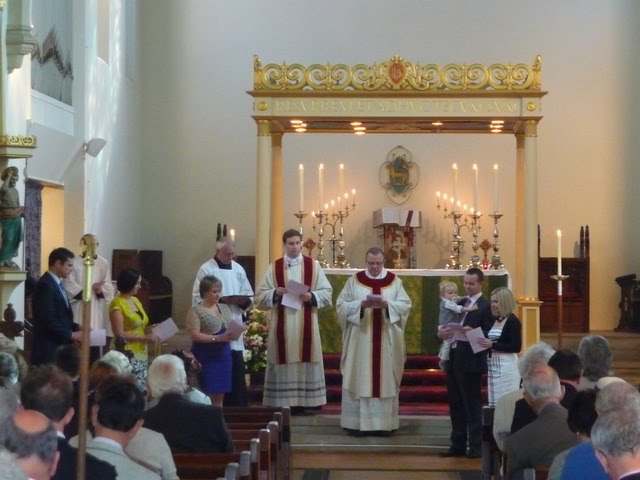
            The Church is both a visible human society in the ‘here-and-now’ and at the same time and into eternity a divine mystery. Here on earth we are a mixture of those in every possible stage of their Christian journey. In his baptism, in a few moments time, Harry will be beginning his.  Moreover, we show a vast array of characters and temperaments. We must allow for all these variations among us, rather than give way to impatience over them. As we grow spiritually these different individual characters and abilities are to find their fulfilment as they are brought into obedience to the divine will. The temptation to gratify self-will is always hanging around, of course. And it is our awareness of our human failings which make one little part of that verse in ‘Firmly I believe…’ appear problematic. What did Newman meant by ‘venerating’ the Church? Venerating is giving respect, not worshipping: worship is for God (see the last verse!). Since the line speaks of venerating ‘Holy Church’ it is a matter of venerating the Church whenever and wherever it is, and has been, faithful in obedience to Christ its head. There is no question of respecting any human element of sinfulness in the Church. Always the standard for the Church is faithfulness to Christ’s teaching in Scripture and faithfulness in the Church’s calling to witness to Christ as its head.

            John Henry Newman [most certainly by this hour Blessed John Henry Newman!] and his colleagues asked the question – and made many in the Church of England of his day ask the question, ‘What is the Church?’  It was Newman, in particular, who was instrumental in bringing back to the Church of England the forgotten understanding, clearly shown in Holy Scripture that the Church is The Body of Christ. Therefore the life lived by the Church is Christ’s life. Moreover, because of its divine institution by Christ himself the Church has no business looking for any other authority than the divine authority that Christ himself has given it.

What is the Church? May we ever be mindful of the question and its answer. Amen.

Monday, 20 September 2010

Newman's Oratory


Good morning from Birmingham where, last evening, I shared in the joy of the Oratorians as we celebrated Solemn Vespers of Blessed John Henry Newman. After Vespers was Benediction and then the opportunity to receive a blessing with the relic of Bl. John Henry Newman and to venerate it. The Shrine at Newman's Oratory in Birmingham is now complete and a fitting tribute to this important figure in the Church's life.

Vespers (in the older form of the Roman Rite) was attended by members of the Catholic hierachy of England & Wales and visiting prelates. There were also Oratorians and their faithful from all over the world. Truly universal!

There is one photo here and the rest can be viewed on my Flickr page here.

Sunday, 19 September 2010

Thank you Holy Father!

Anglicanorum Coetibus


The Holy Father has just recommended to the Catholic bishops of England and Wales to have generosity in the implementation of the Apostolic Constitution Anglicanorum Coetibus.

Thank you Holy Father!
From the speech:
Finally, I should like to speak to you about two specific matters that affect your episcopal ministry at this time. One is the imminent publication of the new translation of the Roman Missal. I want to take this opportunity to thank all of you for the contribution you have made, with such painstaking care, to the collegial exercise of reviewing and approving the texts. This has provided an immense service to Catholics throughout the English-speaking world. I encourage you now to seize the opportunity that the new translation offers for in-depth catechesis on the Eucharist and renewed devotion in the manner of its celebration. "The more lively the eucharistic faith of the people of God, the deeper is its sharing in ecclesial life in steadfast commitment to the mission entrusted by Christ to his disciples" (Sacramentum Caritatis, 6). The other matter I touched upon in February with the Bishops of England and Wales, when I asked you to be generous in implementing the Apostolic Constitution Anglicanorum Coetibus. This should be seen as a prophetic gesture that can contribute positively to the developing relations between Anglicans and Catholics. It helps us to set our sights on the ultimate goal of all ecumenical activity: the restoration of full ecclesial communion in the context of which the mutual exchange of gifts from our respective spiritual patrimonies serves as an enrichment to us all. Let us continue to pray and work unceasingly in order to hasten the joyful day when that goal can be accomplished.

With these sentiments, I thank you warmly for your hospitality over the past four days. Commending all of you and the people you serve to the intercession of Saint Andrew, Saint David and Saint George, I am pleased to impart my Apostolic Blessing to you and to all the clergy, religious and lay faithful of England, Scotland and Wales.

Blessed John Henry Newman - pray for us.

This morning we celebrated Blessed John Henry Newman. After Mass his new shrine was blessed, a reminder for us that we too are called to a life of holiness. The Holy Father has reminded all of us about the need to live a holy life and in Blessed John Henry Newman we have a new model of holiness. We are very pleased that ours must be one of the first shrines in honour of the new beatus.
Roger delivered a very good homily discussing the nature of the Church in the mind of Blessed John. Will he give us the text to put on line? I hope so.
We also celebrated the baptism of Harry, and after Mass we had the opportunity to follow the Mass of Beatification in the Hall and for many to share the wonderful experiences they shared yesterday at Hyde Park. Here are some pics.